11 Nov 26

People call customer service only when a problem is worth the hassle. Most small problems never get that far, so businesses only hear about the ones that do.
Personal agents like Muse and Instinct change that. People text them or talk to them the way they would a human assistant, and the agent goes off to handle the task on the web or over the phone. It reports back when the job is done.
They also do not wait to be asked. An agent connected to someone's inbox and calendar notices the late delivery or the appointment that needs moving, and offers to deal with it.
Each of those calls comes from one of your customers. The person who sent the agent expects the service they would get themselves, and the agent will call back with a new story until it gets an answer.
To serve those callers well, you first have to know which ones are agents. AgentID joins APT in our family of super-reliable models for CX, and it recognizes a personal agent as soon as the call begins. How you route the call from there is your decision.
How AgentID works
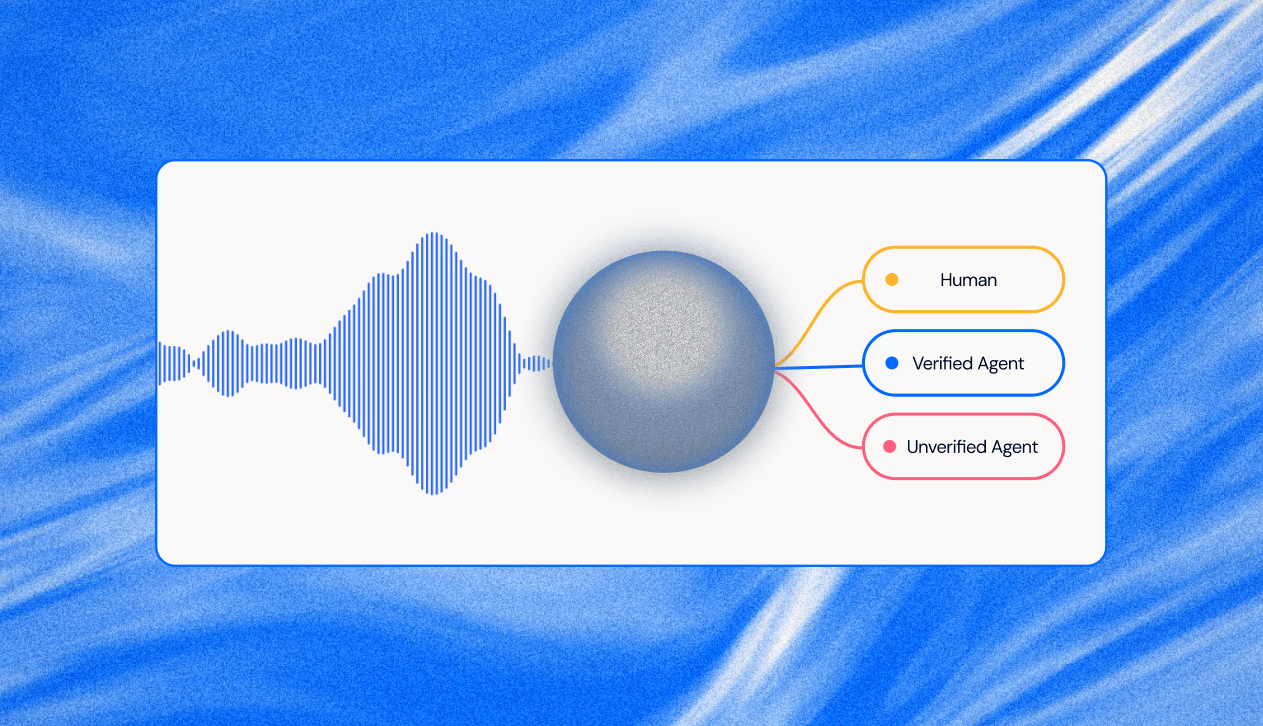
AgentID listens to the live audio of a call and does its work before the conversation gets under way.
- It detects agent speech as the call begins.
- It verifies who the agent represents and what it may do.
- It routes the call however you decide, for example with human callers first and unverified agents held to whatever your policy allows.
There is no registry of known voices to maintain. A brand-new voice is flagged on its first call, and the real customers who call you are recognized as people.
The model needs only the live audio you already have. It sits in front of whatever answers your calls today, an IVR or a voice agent, and that system stays as it is.
The right answer depends on who sent the agent
Knowing that an agent is calling is where the decision starts. An airline would welcome an agent that rebooks a traveler during a storm, and it would not want the same agent calling back again and again to reargue a decision already made. A health plan would answer an agent's question about what a plan covers and keep the claim itself with the member.
The mix of callers will change too. We expect many of the first agent calls to come from people testing limits, and a business will want firm answers ready for those. Before long the agent on the line will belong to one of your best customers, and you will want to give it the service you would give that customer in person.
None of those choices is possible until you know which caller is which and who each one represents, and that is what AgentID tells you. From there APT, our super-reliable intelligence model, carries the conversation and holds your policy on every call. Scaled Cognition Voice gives that conversation a natural, low-latency voice built with the same super-reliability.
The phone needed the same rules as the web
An agent can only tell you who it represents if there is a shared way to say so. The Personal Agent Protocol provides one, and it is the open standard our partner Genesys is developing with Meta and others. It covers websites and APIs, and we have adopted it in full. AgentID extends those terms to the phone, so an agent that calls you is held to the same rules as an agent that visits your site.
Common practice for agent callers will take time to settle, and the companies writing the standard are putting it into production now. We would rather our customers set their terms early than inherit someone else's. AgentID is available today, and you can see how it works.

ALSO BY
No items found.